
Jasmine Tea: How It Is Scented in Fujian, Round by Round
Updated 2026-09-15
Reviewed by tea master Ms. Judy (Wang Mengyu)
Jasmine (moli hua, 茉莉花) is probably the most famous flower in Chinese tea. Its fragrance, delicate and sweet with the cool freshness of a summer evening, has been many people’s very first encounter with Chinese tea.
Taste and aroma in tea
Classic jasmine tea is made in Fujian by an age-old scenting technique: fresh jasmine buds picked during the day open at night next to the tea leaf, and the leaf drinks in their aroma. The cycle is repeated several times - seven or more for the finest grades. Blends sometimes take a simpler route, adding dried blossoms straight to the leaf. Jasmine pairs best with green tea: its freshness lifts the floral sweetness and keeps it from turning cloying.
In the Chinese tradition
For centuries jasmine tea has been the tea of hospitality and gifts, offered to guests and emperors alike. The flower itself is a Chinese symbol of purity and tenderness. In traditional thinking jasmine belongs to the “cooling” aromas: it is said to calm the mind, clear the head and ease tension - which is why jasmine tea is a favourite for evenings and hot days.
How to brew
Green tea with jasmine dislikes boiling water: 80–85 °C and short infusions preserve both the freshness of the leaf and the delicacy of the floral aroma.
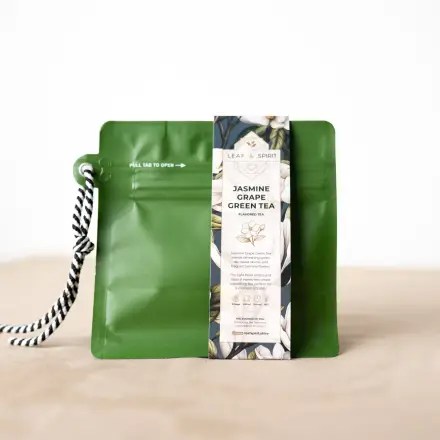
Meet it at its best in our grape jasmine green tea, where jasmine carries the fruit instead of masking it (more in the green tea collection).
How it is harvested and prepared
Jasmine sambac buds are picked in high summer, from mid-morning into late afternoon on sunny days - in Fuzhou that means roughly 10 a.m. to 5 p.m., with buds gathered after 2 p.m. rated best. Dew-wet buds carry too much water and weaken the scent, so nobody picks at dawn. The still-closed mature buds reach the factory the same evening, because they open at night, and that is when they breathe out their fragrance.
Jasmine tea is a scented tea, not a mix of leaf and petals. Spring green tea is held back until summer, then layered with fresh buds through the night as they bloom, the pile kept warm so the flowers give up their aroma. Each round runs ten to twelve hours with spreading-and-cooling to manage the heat; by morning the spent flowers are sifted out and the tea is re-dried, and the whole thing repeats with fresh flowers. It finishes with a light “tihua” pass to lock in the fresh top note. Fuzhou’s scenting method is part of the Chinese tea-making traditions inscribed by UNESCO as intangible cultural heritage in 2022.
On our shelf
You meet jasmine first in our jasmine grape green tea, where the scenting lifts sweet grape over a light green base, and again in the caffeine-free floral & fruit blend among rose, chrysanthemum and peach. In the blend builder jasmine is a 40 ฿ add-on, up to three portions, and there’s a ready-made green-tea-with-jasmine preset to start from. A nice thing to know: in a true scented tea the flowers have already given everything to the leaf and are then sifted out, so the petals you spot in a blend are there for their beauty and a soft floral lift - the real perfume is already tucked inside the tea.
Is jasmine tea made with real flowers?
Yes - classic jasmine tea is scented, not flavoured. Fresh jasmine buds are layered with green tea at night as they open, and the leaf drinks in the aroma over repeated rounds; the spent flowers are then sifted out. Blends that leave visible blossoms in the tea use them for looks and a gentle floral note, which is a different, simpler approach.
Shop Green Tea in our catalog →
Notes on traditional properties are part of Chinese tea culture and are not medical advice.