
Osmanthus Tea: Taste, Brewing and Osmanthus Oolong
Updated 2026-09-28
Reviewed by tea master Ms. Judy (Wang Mengyu)
Osmanthus (guihua, 桂花) is the tiny golden blossom of an evergreen tree that flowers across southern China in early autumn. Its fragrance is one of the most recognisable in Chinese cooking and perfumery: ripe apricot, peach stone and honey with a soft, creamy edge.
Taste and aroma in tea
Tea makers use osmanthus in two ways: scenting the leaf in the classic manner (as with jasmine tea) or blending the dried flowers straight into the tea. Osmanthus oolong is the most famous pairing - the dense, buttery body of the oolong picks up the apricot-honey sweetness of the flowers, giving a round, lingering cup.
In the Chinese tradition
Guihua is the flower of mid-autumn: it opens around the Moon Festival, and in southern China it adds its scent to sweets, wine and tea alike. In traditional thinking osmanthus is associated with warmth - it is said to “warm the middle”, to help digestion and to soothe the throat. Osmanthus tea is traditionally enjoyed in the cool season and after meals.
How to brew
The flowers give up their aroma quickly, so osmanthus tea needs no long steeping: short infusions with water at 90–95 °C open up both the tea base and the floral sweetness.
How it is harvested and prepared
Osmanthus blooms only briefly in autumn, September into early October. Guilin in Guangxi - the name means “forest of osmanthus”, with more than two thousand years of planting behind it - is one of China’s main regions, alongside Xianning in Hubei, Chengdu and Chongqing. The flowers are gathered at full bloom, when the tiny blossoms show the “tiger-claw” shape, in the cool of the morning or late afternoon. Some growers shake or lightly tap the branches so the blossoms fall onto cloths spread below; the best pick by hand to keep every flower whole and golden. Golden osmanthus, jingui, is prized as the most fragrant of the varieties.
Once gathered the flowers are sieved clean of stems and leaves and go to drying within hours, while the scent is still fresh in them. For the dried flowers that go into a blend, producers dry them quickly at low heat - tunnel or heat-pump rooms, or vacuum freeze-drying - in thin layers, chosen to hold the golden colour and the volatile scent. Osmanthus tea proper is made differently: it scents a green or black base jasmine-style, and the spent flowers are sifted out before the tea is re-dried.
On our shelf
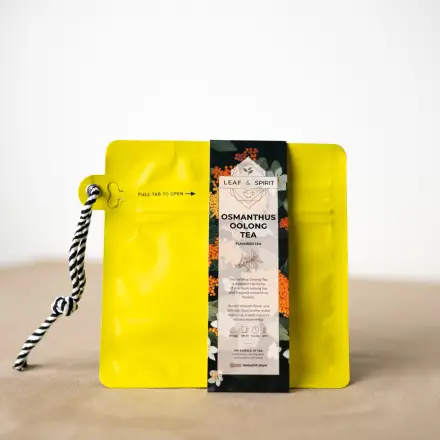
Our Osmanthus Oolong is the house pairing - a buttery oolong that picks up the apricot-and-honey sweetness of the flowers into a round, lingering cup. In the blend builder osmanthus is the one flower priced a little higher, 50 ฿ a portion (up to three), because good golden blossoms cost more. A couple of portions over shou pu-erh with a touch of orange is one of our ready-made starting points.
What does osmanthus taste like in tea?
Osmanthus brings a warm, sweet aroma of ripe apricot, peach stone and honey with a soft creamy edge - one of the most recognisable scents in Chinese cooking. In the cup it rounds the tea out instead of sharpening it, which is why it sits so well on a buttery oolong. The flowers give up their scent quickly, so short infusions catch it at its brightest.
Shop Oolong Tea in our catalog →
Notes on traditional properties are part of Chinese tea culture and are not medical advice.