
Types of Oolong Tea: From Floral to Roasted
Updated 2026-08-29
Reviewed by tea master Ms. Judy (Wang Mengyu)
What Makes a Tea an Oolong?
Oolong is partially oxidised tea: the leaf is bruised and left to darken part-way, then fixed with heat somewhere between green tea and red. Where the maker stops - anywhere from roughly 10 to 80 per cent oxidation - decides whether the same bush tastes of lilac and cream or of embers and baked fruit.
Shape tells you almost as much. Anxi and Taiwan roll the leaf into tight pellets that unfurl over many infusions; Wuyi twists it into dark strips that give their character in the first two cups. Both schools grew up in Fujian, and the family portrait is on our oolong page.
The Oolong Spectrum: From Floral to Roasted
Line oolongs up by oxidation and roast and you get a spectrum. At the light end sit the floral styles - Anxi Tieguanyin and Taiwan's high-mountain teas, with milk oolong beside them. At the dark end, Wuyi rock teas led by Da Hong Pao, then red oolong and GABA oolong.
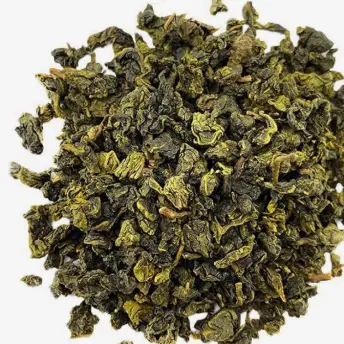
The light end pours green-gold and smells of spring. Milk oolong owes its cream and orchid note to Taiwan's Jin Xuan cultivar, no flavouring involved.
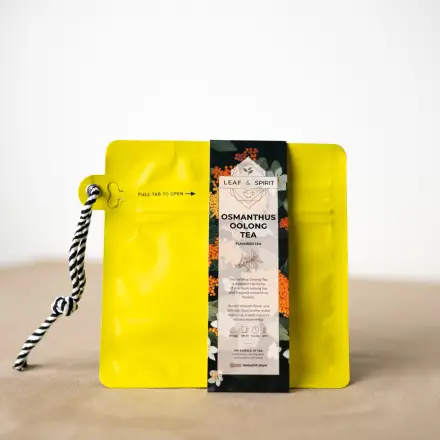
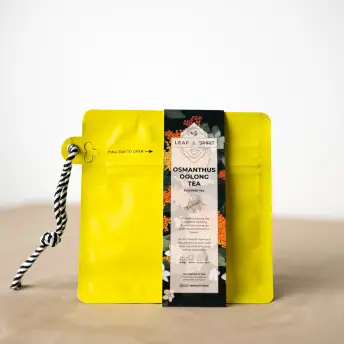
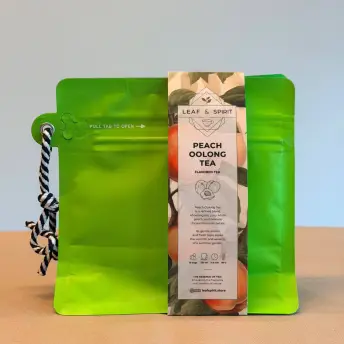
The middle belongs to scented oolongs. A creamy base takes flowers gracefully: our Osmanthus Oolong lays apricot-honey blossom over the leaf, and peach oolong pairs white peach with chrysanthemum.
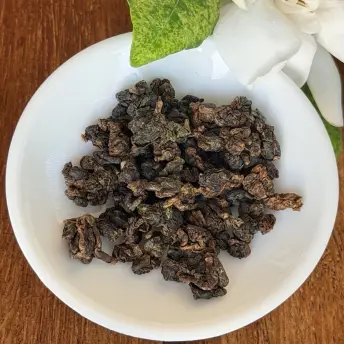
The dark end is roast and deep oxidation. Wuyi rock teas smell of embers and warm stone; red oolong is pushed almost all the way to red tea; GABA oolong goes further still, fermenting without oxygen until the cup turns amber and quietly smoky.
Thailand's Highland Oolongs: Taiwanese Roots in Mae Salong
Some teas on our shelf never saw China or Taiwan. Mae Salong, a mountain village a few hours north of Chiang Rai, was planted decades ago with tea bushes carried over from Taiwan, and its gardens now cover the dark half of the spectrum as well as far more famous names.
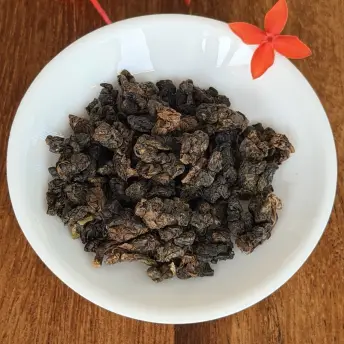
Our Red Oolong No. 12 is named for its cultivar: Taiwan's No. 12, Jin Xuan - the same bush behind milk oolong. Oxidised nearly to red tea, it keeps the cultivar's floral lift over a smooth dark body, silky and naturally sweet. Its neighbour GABA Oolong Amber Smoke ferments under nitrogen and tastes of fermented pear and warm smoke, with a mineral sweetness underneath.
We buy both directly in Mae Salong and brew them every day at our tea house in Phuket. Good oolong no longer stops at the Taiwan Strait.
Which Oolong Should You Try First?
Start from what you already drink. Latte drinkers take to milk oolong at once; lovers of flower teas should begin with osmanthus oolong; if red or black tea is your daily cup, Red Oolong No. 12 will feel like home. For a slow evening there is GABA, traditionally drunk to wind down.
The whole shelf lives in our oolong catalogue, and one method covers it: water at 85–95 °C, a small pot, short steeps, about 3 g per 100 ml. Light styles like the bottom of that range, roasted ones the top.
One habit worth borrowing from gongfu cha (功夫茶, "tea with skill"): hold your verdict until the second or third pour. The aroma opens in steps - flowers, then fruit, then honey - and a good leaf answers differently every pour.
What is oolong tea drunk for?
In Chinese tradition oolong is the tea of the table: drunk after rich food for a light, fresh feeling, and through long afternoons for its gentle, gradual caffeine. GABA oolong adds an evening role - traditionally poured to slow down. What the leaf actually does in the body is a young field of research; take these habits as tea culture, not a prescription.
Shop Oolong Tea in our catalog →
Notes on traditional properties are part of Chinese tea culture and are not medical advice.
Buy from the tea house shelf
 Osmanthus Oolong
from 280 THB
View this tea
Osmanthus Oolong
from 280 THB
View this tea
 Peach Oolong
from 280 THB
View this tea
Peach Oolong
from 280 THB
View this tea
 Milk Oolong
from 480 THB
View this tea
Milk Oolong
from 480 THB
View this tea
 GABA Oolong Amber Smoke
from 650 THB
View this tea
GABA Oolong Amber Smoke
from 650 THB
View this tea
 Red Oolong No. 12
from 690 THB
View this tea
Red Oolong No. 12
from 690 THB
View this tea