
GABA Oolong: How It Is Made, How It Tastes, Where It Grows
Updated 2026-08-29
Reviewed by tea master Ms. Judy (Wang Mengyu)
GABA oolong (jiā yè lóng chá, 佳叶龙茶) is an oolong fermented in an oxygen-free environment. Sealed away from air - usually under nitrogen, the leaf converts its natural glutamic acid into GABA, gamma-aminobutyric acid, at levels many times higher than in ordinary tea. The cup is dark and unusually smooth: an evening tea by temperament.
Taste and character
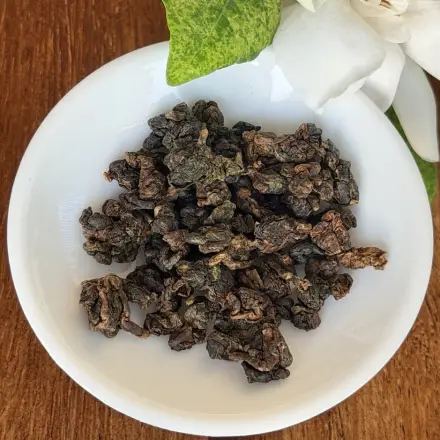
Anaerobic fermentation changes the taste as much as the chemistry. GABA oolong is dark and warming: fermented pear and dried fruit, a mineral sweetness, sometimes a light smoky note, and a finish that many compare to a soft whisky without any sharpness. Unhurried, rounded.
On the oolong spectrum it stands at the far dark end, past the roasted Wuyi styles - our types of oolong guide maps the whole shelf from floral to roasted. Guests at our tastings often guess ripe pu-erh.
How GABA oolong is made
The method comes from Japan. In the 1980s, Tsushida's laboratory found that fresh leaf held under nitrogen stops oxidising and starts converting glutamic acid into GABA. Producers turned that into a craft: sealed tanks, air drawn out and replaced with nitrogen, one or several oxygen-free cycles. After that the tea is finished like any dark oolong - rolled and dried, sometimes with a light bake.
Cut off from air, the leaf trades its floral top notes for fruit and smoke. That trade is the whole style.
From Taiwan to Mae Salong
The technique took root in Taiwan and later travelled to the highlands of Northern Thailand. The mountain gardens of Mae Salong, planted with Taiwanese oolong cultivars decades ago, now produce some of the finest GABA oolong outside Taiwan.
Ours comes from exactly there: old Taiwanese cultivar bushes a few hours north of Chiang Rai. We buy it directly and pour it daily at our tea house in Phuket; on the shelf it goes by GABA Oolong Amber Smoke.
Does GABA oolong have caffeine?
Yes. GABA oolong is real tea from Camellia sinensis, so it carries moderate caffeine, like any other oolong - nitrogen fermentation changes the leaf's amino acids, not its caffeine. The calming reputation comes from the GABA itself. We rate its caffeine three out of five.
GABA is known in the body as a calming neurotransmitter, and this tea is traditionally drunk in the evening for exactly that reason - to slow down. How much survives brewing and digestion is still an open question - the research is young. Treat this as tea culture, not medicine: notes on traditional properties are not medical advice.
How to brew
Water at 95 °C, about 3 g per 100 ml, steeps of 3–4 minutes. A good GABA oolong holds 6–8 infusions, growing softer and sweeter with each one. No rinse needed: the dark leaf opens fast, and an oversteeped cup turns thicker, not bitter.
FAQ
What does GABA oolong taste like?
Dark fruit and rare smoothness: fermented pear and dried fruit, a low smoky warmth at the end. Nothing sharp, nothing grassy. The cup sits closer to roasted oolong or ripe pu-erh than to anything floral.
Does GABA oolong have more caffeine than regular oolong?
No - roughly the same. Anaerobic fermentation raises GABA, not caffeine; the cup stays in the same moderate range as other oolongs. If evening caffeine worries you, steep shorter and drink earlier.
How do you brew GABA oolong?
Water at 95 °C, about 3 g of leaf per 100 ml, steeps of three to four minutes. Good leaf holds six to eight infusions, each softer and sweeter than the last.
Shop GABA Tea in our catalog →
Notes on traditional properties are part of Chinese tea culture and are not medical advice.