
Lavender Tea: Taste, How Much to Use and How to Brew It
Updated 2026-09-25
Reviewed by tea master Ms. Judy (Wang Mengyu)
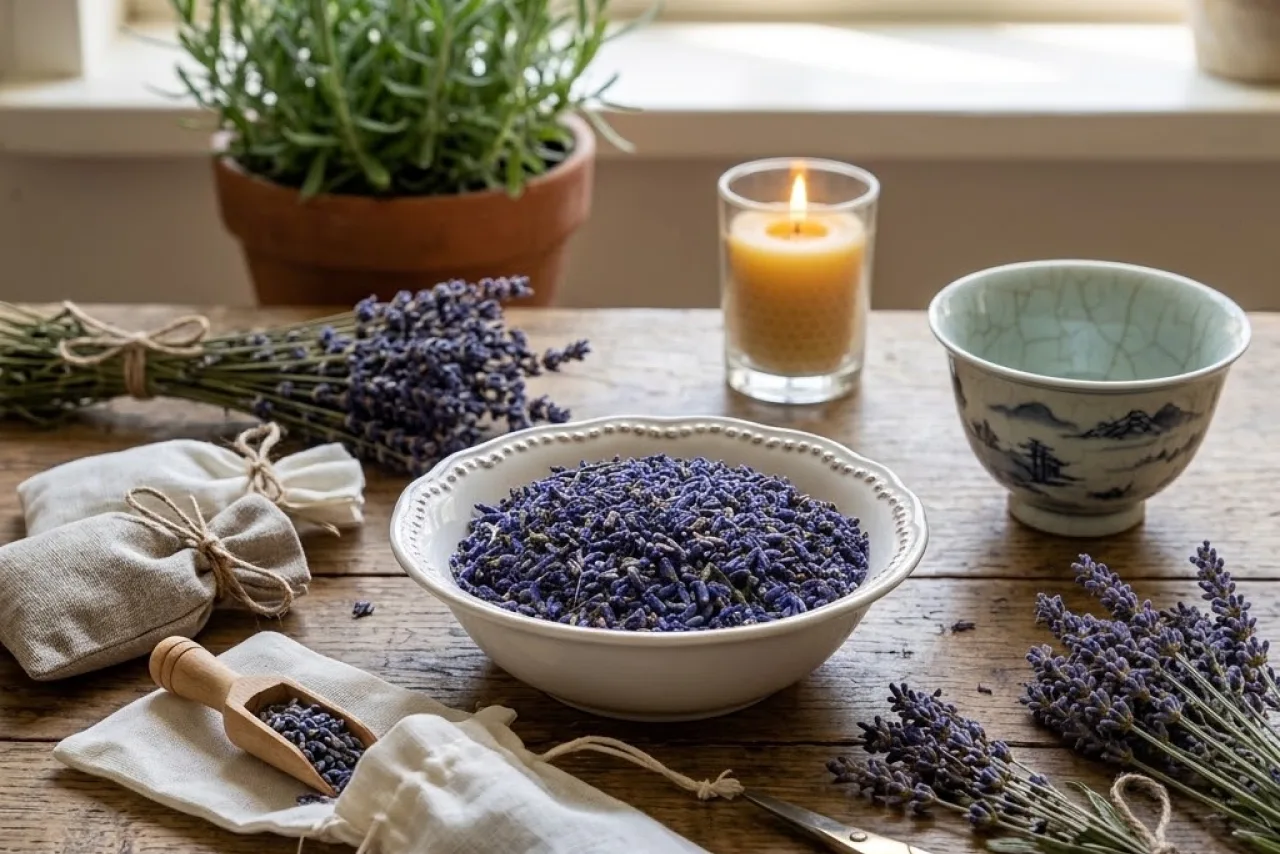
Lavender (xunyicao, 薰衣草) goes into the cup as dried buds: small grey-violet grains stripped from the flower spike just before it opens fully. A pinch smells like a summer field. A spoonful smells like soap, and that difference is most of what you need to know about brewing it.
Taste and aroma in tea
Floral first, then something cool: a little pine, a hint of mint, a faint bitterness at the end. The aroma comes mainly from linalool and linalyl acetate, the same compounds that give bergamot and coriander seed part of their scent. That is why lavender sits so naturally next to black tea: the malt carries it, the floral note lifts the cup.
On its own it brews into a pale, almost colourless infusion with no caffeine. The taste is lighter than the smell promises. Push it, and it turns bitter and perfumed.
A newcomer to the Chinese cup
Lavender is not an old Chinese herb. It came to China from the Mediterranean in the 20th century, and since the 1960s its home there has been the Ili valley in Xinjiang, around Huocheng county: the latitude is close to Provence, the summers dry and sunny. Most of China's lavender still grows there, and in late June the fields turn purple for about three weeks.
In the Chinese cup it behaves as a flower among flowers, next to rose, chrysanthemum and jasmine, in evening blends without tea leaf. In Thailand lavender does not grow in the lowland heat, so here it is almost always dried and imported, and it turns up in cafés as lavender latte and iced lemonade.
How to brew
About 1 g (a level half teaspoon) per 300 ml, water at 90 °C, four to five minutes. Longer than that brings out the bitterness, and more buds make the cup soapy. With honey and a slice of lemon it gets softer and brighter; the infusion even turns faintly pink from the acid.
With tea, think of lavender as seasoning. A pinch on a teaspoon of black tea or oolong is plenty. On a delicate green tea keep it smaller still, or the leaf disappears under the flower.
For a cold version, put 1 g in 500 ml of cold water with a few slices of lemon and leave it in the fridge for four to six hours. Overnight is too long: the bitterness creeps in.
How it is harvested and prepared
For the cup growers cut true lavender, Lavandula angustifolia. Lavandin, the taller hybrid planted for oil and soap, has more camphor and tastes harsh in tea. Spikes are cut in the morning when about half the buds on a spike have opened: the oils are richest then, and the petals have not yet started to fall.
The bunches dry hanging in shade for one to two weeks. Direct sun bleaches the colour and burns off the aroma. Dry spikes are rubbed over a sieve to free the buds, which are then cleaned of stems and dust. Good culinary lavender stays blue-violet and smells strong from an open pouch; grey, dusty buds with little scent are old.
On our shelf
We keep lavender for the blend builder, where it is a 40 ฿ add-on, up to three portions per 100 g pack. One portion is the one we recommend: two grams over black tea or oolong give a clear lavender note without the perfume. Two portions are for people who know they love it. With rose it makes a soft floral pair, and with lemongrass or mint it turns fresh and herbal.
Does lavender tea have caffeine?
Lavender itself has none. On its own it is a herbal infusion that works in the evening. In a blend on a tea base the caffeine comes from the tea leaf.
Why does my lavender tea taste like soap?
Too many buds, too long a brew, or both. Halve the amount first, then cut the time to four minutes. Old buds and lavandin also give a harsher, more camphor taste.
Can I use garden lavender or lavender oil?
Only culinary-grade buds of Lavandula angustifolia that were grown for food and not sprayed like ornamental plants. Essential oil is not for drinking at all: it is far too concentrated. People who are pregnant or take sedatives should ask a doctor before drinking lavender regularly.
Notes on traditional properties are part of Chinese tea culture and are not medical advice.